Vegan Pavlova with Aquafaba Powder — Crisp Meringue, Soft Center

A snow-white pavlova made with aquafaba powder instead of egg whites, topped with coconut whipped cream and fresh berries. The classic Australian dessert, fully vegan.

★★★★★ 5 · 1 reviews
Prep Time 20 min
Cook Time 90 min
Total Time 110 min
Servings 8
Difficulty Intermediate
Cuisine Australian
Jump to Recipe

Pavlova is the most romantic dessert in the baking canon. A cloud-like meringue shell with a crisp outside and a soft marshmallow center, crowned with whipped cream and fresh fruit. It's beautiful, dramatic, and looks far more complicated than it actually is. The traditional recipe relies on egg whites — which is what kept this dessert off the table for vegans, dairy-free guests, and anyone allergic to eggs.

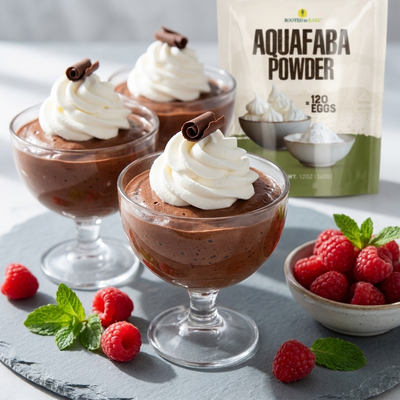
Aquafaba powder changes that. Rooted in Rare's Aquafaba Powder whips into stiff, glossy peaks just like egg whites, holds its structure in the oven through a long low bake, and produces a meringue with the exact crisp-shell, soft-center contrast that defines a great pavlova. Reverse-engineered chickpea-water magic, bright white, consistent every batch — no draining cans, no bean smell, no batch-to-batch variability.

This vegan pavlova is the dinner-party dessert that breaks the rules in the best way: it's stunning, fully plant-based, and tastes IDENTICAL to a traditional pavlova. Serve it after a summer dinner, for a birthday, for Easter brunch, for any occasion that calls for something dramatic and beautiful. Top with whatever's freshest — berries in summer, stone fruit in late summer, pomegranate and citrus in winter.

The trick is patience: the meringue bakes low (225°F) for 75-90 minutes, then cools fully in the turned-off oven (another hour). Don't try to rush it — the slow bake-then-cool is what creates the signature crisp shell and prevents cracking. Plan a leisurely 3-hour window when the oven is doing the work and you're free to do other things.

Ingredients

servings

Instructions

  1. Prep oven and pan

    Preheat oven to 225°F (110°C). Line a baking sheet with parchment paper. Draw a 9-inch circle on the parchment as a guide (trace a plate). Flip the parchment so the pencil mark is underneath but still visible through.

  2. Rehydrate the aquafaba

    In a small bowl, whisk together the aquafaba powder and cold water until fully dissolved. Let sit 5 minutes to hydrate fully.

  3. Start whipping the meringue

    Transfer the hydrated aquafaba to the bowl of a stand mixer fitted with the whisk attachment. Add the cream of tartar. Whip on medium-high speed for 5 minutes until soft peaks form — they should hold but curl over when the whisk is lifted.

  4. Add the sugar slowly

    With the mixer running on medium-high, add the superfine sugar one tablespoon at a time. Don't dump — slow addition is what gives meringue its glossy stable structure. Each spoonful should incorporate before the next is added. This step takes about 4-5 minutes.

  5. Whip to stiff peaks

    Continue whipping for another 3-5 minutes until the meringue is glossy, stiff, and holds sharp peaks. Test by rubbing a bit between your fingers — it should feel smooth, not gritty. If gritty, whip another minute until the sugar fully dissolves.

  6. Fold in stabilizers

    Sprinkle the vinegar and cornstarch over the meringue and add the vanilla. Fold gently with a spatula just until incorporated — 3-4 strokes. Don't deflate.

    Process shot for the Vegan Pavlova with Aquafaba Powder recipe showing the key building or assembly step in progress
  7. Shape the meringue

    Spoon the meringue onto the parchment-lined pan, mounding it within the traced 9-inch circle. Use the back of a spoon to create a slight crater in the center (where the cream will go) and decorative swoops up the sides. About 2 inches tall in the center.

  8. Bake low and slow

    Place in the oven and bake for 75-90 minutes — the meringue should look crisp on the outside, pure white (no browning), and feel firm when tapped. If you smell caramelization or see browning, lower the oven by 25°F immediately.

  9. Cool in the turned-off oven

    Turn off the oven and leave the door closed. Let the meringue cool COMPLETELY inside the oven — at least 1 hour, ideally 2-3. This slow cooling prevents the dramatic cracking that comes from sudden temperature changes. (Small surface cracks are normal and add character; large cracks ruin the look.)

  10. Make the coconut whipped cream

    Open the chilled coconut milk can. Scoop just the solid thick cream off the top (save the watery liquid for smoothies). Whip in a chilled bowl with the powdered sugar for 2-3 minutes until fluffy and holding soft peaks.

  11. Assemble and serve

    Just before serving, transfer the cooled meringue to a serving plate (handle gently — it's fragile). Top with the coconut whipped cream in the center crater. Crown with fresh berries, sliced kiwi, and passion fruit pulp if using. Serve within 30 minutes for the best crisp-shell contrast — the meringue softens once the cream sits on it.

    Macro close-up detail shot of the finished Vegan Pavlova with Aquafaba Powder

Frequently Asked Questions

Why use aquafaba powder instead of canned aquafaba?
Pavlova specifically benefits from consistent protein content because the meringue has to hold its shape through 90 minutes of low-temperature baking. Canned aquafaba varies wildly — sometimes it whips perfectly, sometimes it deflates 20 minutes into the bake. The powder is engineered for consistent foam stability, which means you get a pavlova that holds its shape every single time.
What if my meringue cracks badly?
Some small cracks are normal — they add rustic character. Large cracks usually mean the oven was too hot or you cooled too quickly. Solutions: (1) Verify your oven temp with a separate oven thermometer (many run hot). (2) Let the pavlova cool in the turned-off oven with the door closed for at least 1 full hour. (3) Don't open the door during baking — the temperature drop causes cracking.
Why does the meringue have vinegar and cornstarch?
The vinegar acidifies the foam slightly, which helps stabilize the proteins and creates the soft marshmallowy center that defines a pavlova (as opposed to a fully crisp meringue). The cornstarch binds water in the center and reinforces the soft texture. Both are classical pavlova techniques that work the same way with aquafaba as with egg whites.
Can I make the meringue ahead of time?
Yes — bake the meringue up to 24 hours ahead. Once fully cooled, store in an airtight container at room temperature (NOT the fridge — humidity will soften the shell). Top with cream and fruit within 30 minutes of serving. Adding cream too early softens the shell over time.
Can I make this gluten-free?
Yes — the recipe is naturally gluten-free as written. Aquafaba, sugar, vinegar, cornstarch, vanilla, coconut, and fruit all gluten-free. Just verify your powdered sugar brand isn't packaged in a facility with wheat (cross-contamination can occur with some brands).
What's the best fruit topping?
Classic pavlova toppings are bright contrasting fruits that cut the sweetness: strawberries, raspberries, blueberries, kiwi, passion fruit. For autumn, swap to pomegranate seeds with sliced persimmons. For winter, try mango with passion fruit. For spring, try poached rhubarb with strawberry. Avoid juicy fruits that release liquid (cut peaches, watermelon) — they make the meringue soggy fast.
How long does the assembled pavlova keep?
Once topped with cream and fruit, the pavlova softens within 1-2 hours as the meringue absorbs moisture. It's still delicious for up to 24 hours but the dramatic crisp-shell contrast fades. For the best experience, top within 30 minutes of serving and don't refrigerate leftovers — they get sad and rubbery.
Can I make individual mini pavlovas instead of one big one?
Absolutely — pipe the meringue into 8 small 3-inch rounds with a slight crater in each. Bake for only 50-60 minutes (smaller = faster). Cool the same way, then top individually. They're elegant for plated desserts at dinner parties.